Your Acne Scars
Won't Respond to
Anything You've Tried.
Here's Why.
You've optimized your training. Your diet is clean. Your grooming is locked in. But your skin texture — specifically those scars — won't budge. That's not a discipline problem. That's a depth problem. And once you understand the difference, the fix is obvious.
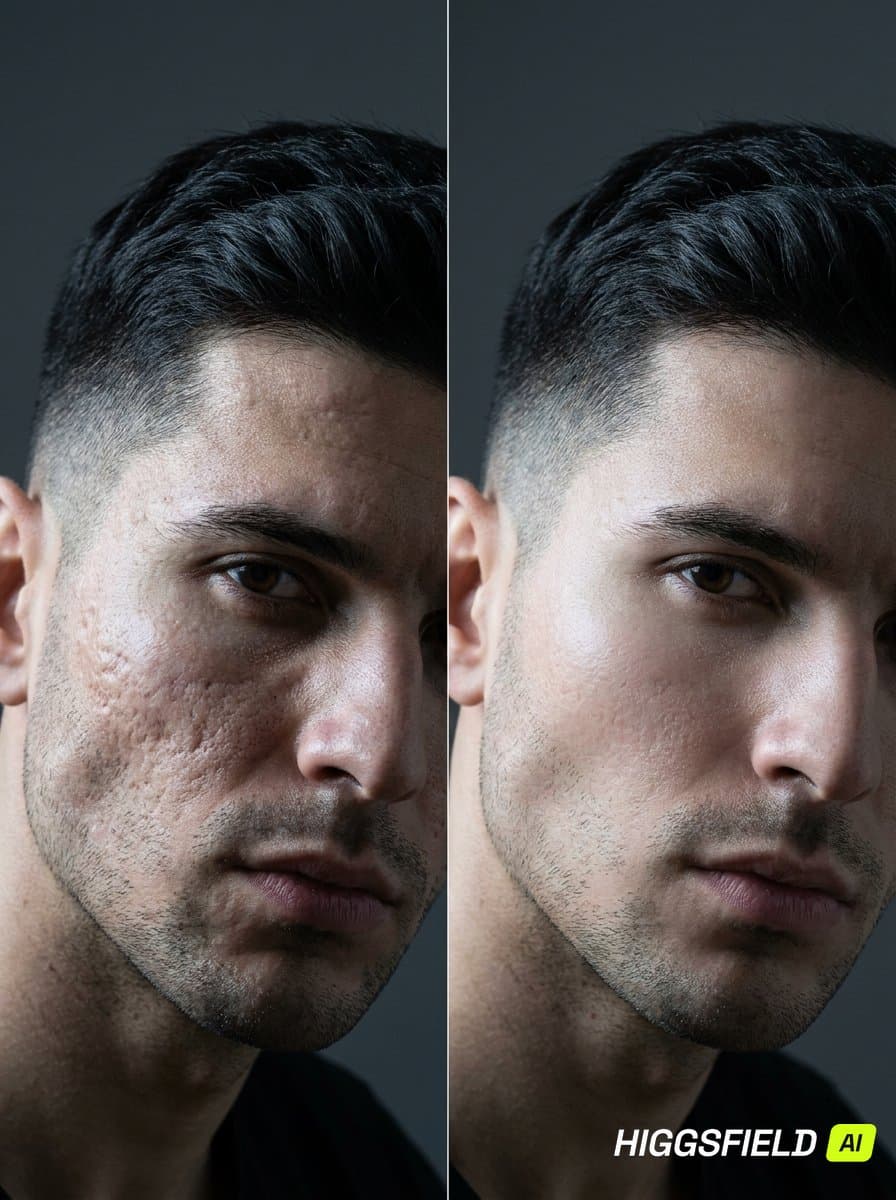
Results shown at 12 weeks · Collagen Induction Protocol · No clinic involvement
01 — The Problem
You've Done
Everything Right.
The Scars Are Still There.
If you've been looksmaxxing with any kind of seriousness, you've already hit the major levers. Training is producing results. Your body composition is moving. Your grooming is sharp. You've researched the optimal haircut, the right skincare basics, the best SPF.
But there's one variable that refuses to respond to discipline: the acne scars from your teens or early twenties.
You've tried niacinamide. Retinol. Vitamin C. Maybe a glycolic acid routine. Some combination of all of them, probably optimized based on forum recommendations and dermatology subreddits. You were consistent. You gave it time. And the texture barely moved.
Most guys at this point draw one of two conclusions: either nothing works, or only clinic treatments work. Both conclusions are wrong. The real answer is simpler — and once you understand it, it changes everything.
“I've put in serious work everywhere else. The one thing I can't seem to fix is the scarring from when I had bad acne at 16. Topicals have done nothing. I need to understand what actually causes the structural change.”
— r/Looksmaxxing, 847 upvotes
That guy is describing a mechanism problem, not a product problem. He doesn't need a better serum. He needs to understand why serums — all of them — will never solve what he's dealing with.
02 — The Mechanism
The Skin Barrier
Was Designed
to Block Everything.
Here's the part no skincare brand wants you to understand, because it makes their entire product line irrelevant:
Your skin's outer layer — the stratum corneum — is a selective barrier specifically designed to keep foreign substances out of your body. This is not a flaw. It's a feature. It keeps pathogens out, regulates water loss, and maintains your body's internal environment.
But it also means that no topical product, regardless of formulation quality or active concentration, can deliver meaningful amounts of active ingredients to the dermis — the layer where your actual scar tissue and collagen deficit live.
Dermatology Basics — Why Topicals Plateau
Where the Damage Is vs. Where Products Land
Acne scars are not a surface problem. They're a structural deficit in the dermis — the deep skin layer where collagen and elastin give skin its structure and volume. When acne heals, the body's normal collagen response is disrupted. The surface seals over, but the scaffolding underneath doesn't fully rebuild.
Topical products operate almost entirely within and just below the epidermis. Retinol accelerates surface cell turnover. Vitamin C supports surface-level antioxidant activity. Niacinamide reduces surface redness and oil. All useful. All working on the wrong layer for scar correction.
This is not about product quality. It's about physics. You cannot apply your way to collagen synthesis. It must be triggered from within.
0%
of topical products reach the dermis in meaningful concentrations — regardless of how much you spend
~1%
annual collagen decline after your early 20s — compounding every year you don't address it
4–8
weeks for new collagen to build beneath the surface after the correct stimulus is applied
The frustrating truth: you weren't doing it wrong. You were using the right tools for the wrong job. Topicals are maintenance. They're not structural repair. For structural repair, you need a mechanism that actually reaches the dermis. There's only one that does — and dermatologists have been using it for 30 years.
03 — The Solution
The Only Mechanism
That Actually Reaches
Your Scar Tissue.
Collagen Induction Therapy — CIT — has been used in clinical dermatology since the mid-1990s. It's not a trend. It's not a cosmetic industry invention. It's a protocol built on basic wound-healing physiology, and it's the mechanism behind the clinical microneedling procedure that currently costs $300–$500 per session at a med spa.
The Wound-Healing Cascade — How CIT Triggers Collagen
Controlled Signal → Collagen Response
When the skin detects micro-injury — even an extremely small one — it initiates the wound-healing cascade: a sequence of biological responses that floods the site with collagen, elastin, and growth factors to rebuild damaged tissue.
Microneedling creates thousands of microscopic channels per second — invisible to the naked eye, but large enough to trigger that repair response. These are not wounds. They are controlled signals. The body reads them as damage requiring repair and responds by synthesizing new collagen in the dermis — exactly where your scar tissue is.
Over 4–8 weeks, that new collagen fills in the structural deficit beneath old scars. Texture smooths. Indentations lift. The shadow-and-light effect that made scars visible diminishes. This is structural rebuild — happening using your own body's repair mechanism, triggered on demand.
The micro-channels also create a temporary window for topical absorption: serums applied immediately post-treatment penetrate up to 80% deeper than standard application, compounding the result.
This is the mechanism behind every clinical microneedling result you've seen. The before/afters aren't photoshopped. The science is not new. The only thing that's changed is that you no longer need a $400 appointment to trigger it.
“The science of collagen induction makes sense to me. What I didn't know is whether a home device can actually reach the depths needed to trigger that response. Turns out — it can.”
— Forum post, r/SkincareAddiction
04 — The Clinic Myth
Why You Think
You Need a Professional
(You Don't.)
The default assumption in this space is that real microneedling results require clinic equipment and a trained practitioner. That assumption is worth examining — because it's costing a lot of guys either thousands of dollars or, more commonly, inaction.
The Pricing Reality
What Clinics Actually Charge You For
A single clinical microneedling session runs $300–$500. Most practitioners recommend 4–6 sessions as a starting protocol. That's $1,200–$3,000 minimum — before maintenance sessions are factored in.
The actual consumable cost per session: under $15. One sterile cartridge tip. The rest is rent, staff, liability insurance, practitioner markup, and the spa environment you're paying for whether you want it or not.
The “you need a professional” narrative exists because there's a significant revenue stream attached to keeping you in the appointment cycle.
Here's what actually matters for results: needle depth, stamp precision, and consistency. Not the clinical setting. Not the certificate on the wall. Not the ambient music and the consultation fee.
The mechanism that drives collagen induction is the same whether it's triggered in a med spa or in your bathroom. What the clinic charges for is overhead — not a result you can't replicate at home.
There's also the environmental factor. Most guys in this space are not going to book a med spa appointment, sit in a waiting room, and explain what they're hoping to address to a stranger. That's not the environment. And the results shouldn't require it.
The mechanism is the same at home. The setting is the only difference — and the setting doesn't build collagen.
See the Protocol →05 — At-Home vs. Clinic
Not All Devices
Are the Same.
Here's What Matters.
The at-home microneedling category has a credibility problem — and it's earned. The market is flooded with cheap dermarollers that don't work, aren't safe, and have given a lot of guys a bad experience that put them off the entire category.
The distinction matters. There are two fundamentally different mechanisms being sold under the same name:
- —Dermarollers (drag-and-tear mechanism): A wheel studded with needles rolled across the skin at an angle. The needles enter at an angle and exit at a different angle, creating irregular micro-tears rather than clean vertical channels. Inconsistent depth, inconsistent results, higher irritation risk. This is not the clinical mechanism. This is a consumer shortcut that doesn't replicate it.
- —Electric microneedling pens (vertical stamp mechanism): A motorized cartridge that stamps straight down and straight up — identical geometry to clinical devices. Consistent depth on every stamp. Adjustable needle length (0.25mm–2.5mm). Replaceable sterile cartridges. This is the actual mechanism. This is what the clinic uses.
The quality gap between a cheap Amazon dermaroller and a precision electric pen is not a marketing claim. It's a mechanical difference that directly determines whether the wound-healing cascade is triggered correctly or not.
| Feature | Dermaroller | Dermaxx Pen |
|---|---|---|
| Needle entry angle | Diagonal drag | Vertical stamp |
| Depth consistency | Variable | Precision-controlled |
| Matches clinical mechanism | ✗ | ✓ |
| Sterile replaceable tips | ✗ | ✓ |
| Adjustable depth settings | ✗ | ✓ |
| Collagen induction at correct depth | ✗ | ✓ |
If you tried a dermaroller and got minimal results, you didn't try microneedling. You tried a different device with a different mechanism. That's the distinction that matters — not “at-home vs. clinic,” but “correct mechanism vs. incorrect mechanism.”
06 — The Protocol
What the
Actual Routine
Looks Like.
The reason most guys never start is they assume the protocol is complicated, time-intensive, or requires specialized knowledge. It's not any of those things. Here's exactly what it looks like in practice:
- —Frequency: Once per week. Not daily. Not every other day. The collagen induction cycle requires recovery time — weekly sessions are the clinically validated frequency for home-use depths. This is 15–20 minutes, once per week. Less time than driving to a clinic.
- —Depth for beginners: 0.5mm–0.75mm. This is the sweet spot for acne scar treatment at home — deep enough to trigger the wound-healing cascade, well within the safe zone for unsupervised use. Most pens offer clearly labeled depth increments. Start conservative. The protocol is forgiving.
- —Post-treatment: Hyaluronic acid serum. Applied immediately after treatment while the micro-channels are open. This is when topicals actually work — penetrating up to 80% deeper through the temporary channels. Standard HA serum. Nothing proprietary required.
- —Timeline for visible results: 4–8 weeks. Collagen synthesis is not immediate. The structural rebuild happens beneath the surface over weeks. Photos are your friend — the changes are gradual but cumulative and real.
- —Maintenance after initial protocol: Once every 2–4 weeks. Once the correction is made, maintenance sessions sustain the result and continue improving overall texture. This is where the ROI compounds — ongoing results at a fraction of a single clinic session's cost.
07 — Results
What Guys Who
Actually Did This
Are Saying.
Not models. Not clinic case studies. Regular guys — same age range, same scar types, no professional supervision — documenting their protocols and results publicly.
Marcus T., 24
Ice pick scars · 10 weeks
“I spent two years trying every topical recommended on the skincare subs. Nothing touched the actual indentation. Eight weeks into the pen protocol and I can see the scars filling in. Not gone, but the shadow effect in photos is noticeably reduced. This is the first thing that's actually moved the needle on scar texture.”
Jordan K., 27
Rolling scars · 12 weeks
“I was deep in the research phase for months. Kept reading that at-home devices weren't worth it. Then I understood the difference between dermarollers and actual pen devices — completely different mechanism. Twelve weeks in, my skin texture has improved more than it did in two years of skincare routines. Wish I'd started earlier.”
Ryan L., 22
Mixed scar types · 8 weeks
“The looksmaxxing approach to this actually makes sense once you understand the biology. Gym fixed the body, this is fixing the face. Already getting comments that my skin looks different — nobody knows what I'm doing differently. The protocol is genuinely simple once you start.”
Alex D., 29
Post-acne texture · 16 weeks
“I looked at clinic prices and did the math. Nearly $2,000 for the recommended session protocol. The pen cost a fraction of that. At week 16 the improvement in my scar texture is comparable to what I've seen in clinic before/afters — without a single appointment, consultation fee, or uncomfortable conversation.”
08 — The Math
The ROI Case
Is Straightforward.
You think in optimization terms. Here's the optimization calculation on microneedling:
Clinic protocol
Initial 4–6 sessions at $350–$500/session
$1,400–$3,000
Clinic maintenance
Recommended every 4–6 weeks ongoing
$4,200+/yr
Dermaxx Pen
One-time device cost
One-time
Cartridge tips
Ongoing consumable per session
~$2–3 each
Break-even point
Device pays for itself vs. clinic
Session 1
The math isn't close. One clinic session costs more than the device itself. Every session after that — for the rest of your life — is two to three dollars in cartridge tips.
The compounding argument is the one worth sitting with: collagen production is time-cumulative. Every week you're not running the protocol is a week of new collagen you're not building. The guys who started six months ago have six months of structural improvement over the guys still in the research phase. Time is the one variable that doesn't wait.
Bottom Line
Your Scars Are
a Structural Problem.
This Is the Structural Fix.
Topicals can't reach them. Discipline alone won't rebuild the collagen deficit. The clinic will charge you $400 per session for a mechanism you can replicate at home — on your own schedule, without the environment, without the appointment, without explaining yourself to anyone.
The mechanism is real. The results are documented. The ROI is obvious. The only question is how many weeks you want to wait before starting.
See the Full Protocol & Device →No clinic required · Ships same day · 30-day guarantee